
International
Bank insolvency in Brazil: why extrajudicial liquidation needs a separate analysis
A financial institution's distress does not automatically follow ordinary corporate reorganisation procedures. Foreign creditors should first identify the applicable regime, responsible authority and subsequent decisions affecting their claims.
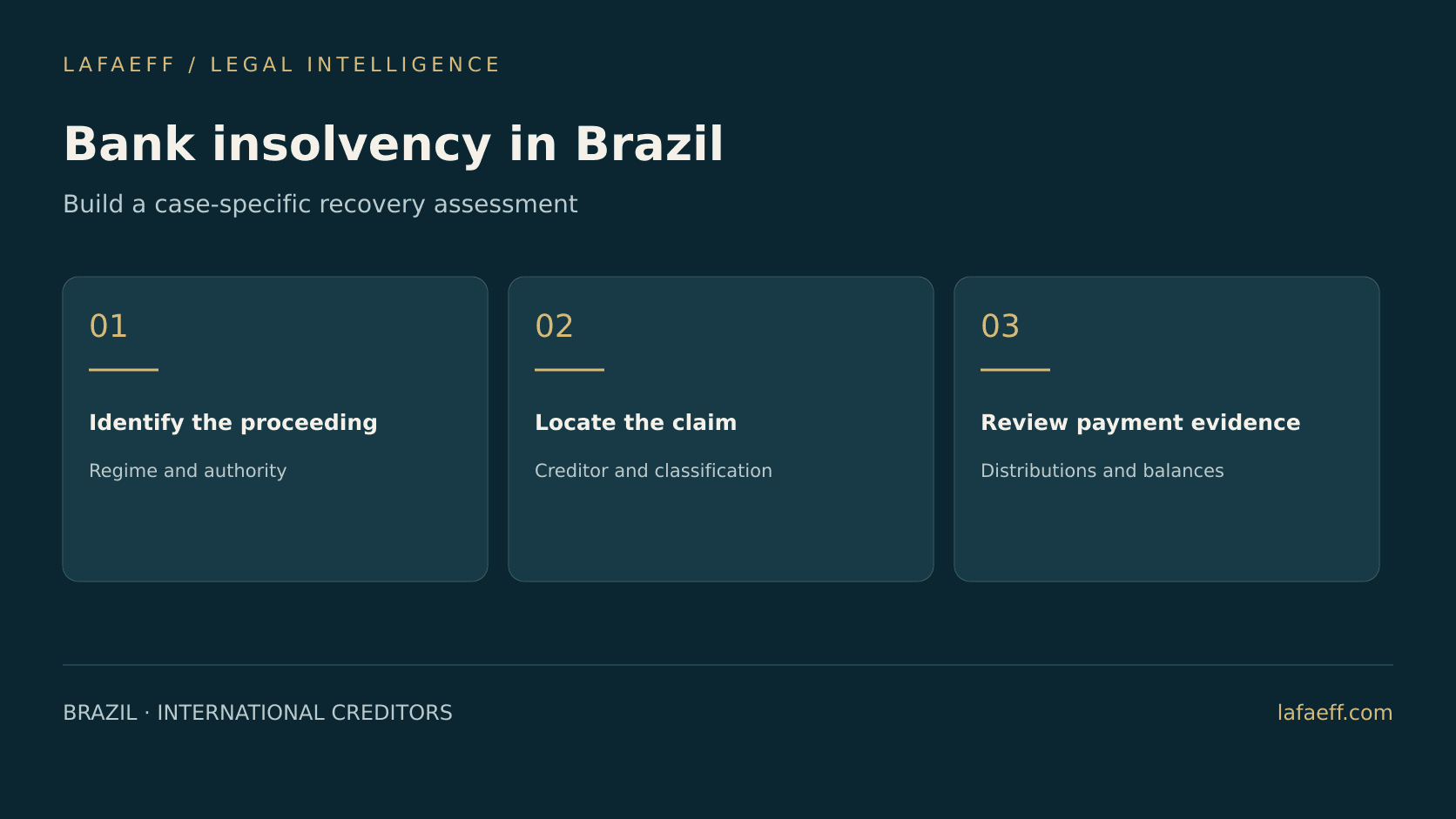
Bank insolvency describes situations that cannot simply be treated as ordinary corporate judicial reorganisation. Law 6,024 of 13 March 1974 governs intervention and extrajudicial liquidation of financial institutions. Article 2(II) of Law 11,101/2005 excludes specified financial entities from its ordinary regime. Law 6,024 covers private institutions, non-federal public institutions and credit cooperatives. Article 197 allows supplementary application of Law 11,101/2005 to these regimes where applicable.
Intervention and liquidation serve different purposes. The Central Bank explains that intervention aims to contain worsening financial risk or irregular practices, while extrajudicial liquidation seeks an institution's orderly exit from the financial system. A bank's trading name or the suspension of its business does not, by itself, establish which regime applies.
The liquidator has management and claim-verification responsibilities. The legislation also provides circumstances in which permission to seek bankruptcy may be granted. If the process moves to court, creditors must identify the proceedings, relevant order and treatment of their claims, rather than assume that every step taken in the administrative stage remains sufficient.
For an overseas creditor, a useful file includes the instrument opening the regime, notices, the claim submission or admission, contested-claim decisions and documented payments. When the debt originates in securities, records connecting the investment to the correct debtor entity should be preserved. A corporate group, brand and issuing entity are not necessarily the same legal person.
Comparisons between cases should start with that evidence. A deadline from a different bankruptcy or a general corporate-reorganisation rule may not address the particular claim. A chronology of responsible authorities, decisions and changes of regime provides a sounder basis for deciding what to do next and assessing timing. It does not establish that a specific distribution or recovery percentage will follow.
Sources
Read the original source · Legislation published on
- Banco Central — Lei 6.024/1974, arts. 1º, 12, 16 e 21 Published on date unavailable · Accessed on
- Lei 11.101/2005 — texto atualizado, Câmara dos Deputados Published on date unavailable · Accessed on
- Banco Central — perguntas frequentes sobre liquidação extrajudicial Published on date unavailable · Accessed on
- Lei 6.024/1974 — dados da publicação original no DOU Published on · Accessed on
Related legal services
Brazilian legal representation
LAFAEFF Advogados · Nikolai Lafaeff · OAB/SP 392.692.
Portuguese and English communication for clients and law firms abroad. An assessment considers the documents, the proposed scope and the legal measures available in Brazil.