

Could your company have unclaimed funds in Brazilian court cases?
How a review of litigation records can trace settlements, deposits and distributions back to the company’s accounts.
Legal perspectives
Brazilian legal guides for foreign businesses, creditors and law firms: debt collection, asset recovery, disputes and hiring Brazilian counsel.

Practical guides, case analysis and official developments for people and businesses with interests in Brazil. Each sourced article distinguishes the original publication date from the LAFAEFF analysis date. Explore the issue, supporting sources and related Brazilian legal services in English or Portuguese.
86 published articles
Hiring Brazilian counsel, working in English and addressing foreign business interests in Brazil.
How a review of litigation records can trace settlements, deposits and distributions back to the company’s accounts.

The purchase order, delivery record and buyer’s last email can help a foreign supplier assess its options in Brazil.

What Brazil’s IDPJ procedure means and why the fate of the company’s assets matters.
How to check who deposited the funds, who was entitled to receive them and whether the payment arrived.
Where foreign suppliers can check their claim, bankruptcy distributions and any deadline requiring action.
How an overseas creditor can use the bankruptcy docket, the estate accounts and the separate list for Brazil’s credit guarantee fund.
Where to find the Mabe creditor schedule and how to read its payment and reserve columns before assessing a possible distribution.
How to locate the Banco Pontual creditor schedule, check which classes a distribution plan covered and trace a payment to the recorded holder.
Where to find the distribution order and how an overseas creditor can trace a payment through a bank or custodian.
The consolidation order identifies the lead case. The September 2026 provisional schedule helps creditors find entries and distinguish reserves.
A foreign arbitral award may support a claim against assets in Brazil, but recognition by the Superior Court of Justice and enforcement are distinct stages with different requirements and risks.
In a Brazilian bankruptcy, proving a debt, having it recorded in the proceeding and receiving payment are separate steps. Evidence, statutory classification and available assets all matter.
The ruling concerns foreign audiovisual works exploited in Brazil.
Original source published on
The fourth-distribution order and notice identify the calculation base, timetable and documentation requirements. Foreign creditors should read them together before treating a listed balance as a payment already cleared for release.
Document datedExcluding fiduciary claims from Brazilian reorganization does not eliminate temporary protection for essential capital assets. Decisions issued in 2026 clarify when protection ends and why the chronology of title consolidation can determine the outcome.
Decision published onArticle 83(5) preserves an assigned claim's nature and classification, but older Brazilian bankruptcies require a separate transitional analysis. The assignment date alone does not determine which statutory ranking regime applies.
Decision published onBrazil's Superior Court of Justice recognized a woman's standing to seek recognition of her late husband's earlier divorce, granted by a German court.
Original source published onCourt allocation of an asset requires prior attachment. Overseas creditors should also assess transfer, holding and resale implications.
Original source published onThe STJ distinguished an extraconcursal legal-fee claim from the cap applicable to the ordinary bankruptcy category at issue.
Original source published onAn overseas forum clause requires assessment of the legal relationship and the practical barriers to bringing proceedings.
Original source published onThe notification of a clarification ruling can determine the annulment deadline. International teams should retain the full sequence of notices.
Original source published onA claim's position in Brazilian bankruptcy depends on its origin, legal character and applicable statutory regime. Understand estate-priority claims, ordinary unsecured claims and subordination, while keeping the bankruptcy hierarchy separate from payment terms under a judicial reorganization plan.
Decision published onA private signature platform may be acceptable, but the document’s purpose, formal requirements and authentication evidence remain decisive.
Original source published onREsp 2,070,288 rejects waiting until reorganization creditors are paid, but does not authorize every individual enforcement action. The analysis must separate the actual advance, financial charges, final judgments and the payment order applicable in bankruptcy.
Decision published onA foreign creditor may need to establish the debt before filing its amount. Understand the documents and procedural questions involved.
Original source published on
The maximum period for filing a claim or requesting a reserve differs from the ordinary filing deadline. Assessing a late claim requires reconstructing dates, identifying the governing regime and checking distribution consequences, even while bankruptcy proceedings remain open.
Decision published onUsing an overseas decision as evidence differs from enforcing its relief. Foreign counsel should define the intended Brazilian legal effect.
Decision published onAssessing service requires identifying the rules governing the foreign proceeding and the contract under examination.
Original source published onREsp 1,503,485 distinguishes debt collection from recovering property subject to fiduciary ownership.
Original source published onThe STJ preserved Brazilian jurisdiction over objections to enforcement brought by a foreign bank undergoing liquidation. The ruling calls for careful separation of forum selection, the debtor's defense, and assistance to foreign insolvency proceedings.
Decision published onA Brazilian ruling on a 90% write-down highlights the need to assess voting rules, commercial reasons and the proposed recovery.
Original source published onAn offer from another shareholder requires procedural safeguards. Foreign creditors should assess price, payment conditions and response deadlines.
Original source published onREsp 1,954,441 separates a claim's original currency from conversion for voting. Learn which records support a filing, how to examine currency modification clauses, and why a Brazilian real equivalent does not itself establish a waiver.
Original source published onArticles 77 and 38 of Brazil's Law 11,101/2005 give currency conversion different functions. A numerical example explains the implications for voting, bankruptcy claims and the records required to verify each calculation.
Original source published onWhen a Brazilian buyer disputes performance, invoices and account statements may need supporting delivery records and technical evidence.
Original source published onThis consumer-law precedent requires attention to the basis for veil piercing and the controllers' management role.
Original source published onA debtor’s company interest may be relevant to enforcement, but ownership, value and the applicable liquidation procedure need verification.
Original source published onA sale above the plan assumptions may justify renewed creditor scrutiny. Headline proceeds do not equal an immediate distribution.
Original source published onForeign creditors should distinguish public records, court-authorised enquiries and financial intelligence systems with restricted purposes.
Original source published onAn economic relationship does not replace the procedure for establishing liability of an entity outside the litigation.
Original source published onA copy may support a payment-order claim, but overseas creditors still need to establish ownership, custody and any transfer of the instrument.
Original source published onSeparate the filed amount from the balance under the approved plan when reporting a Brazilian claim to an overseas creditor.
Original source published on
Verify the lawyer, define scope and compare communication and costs. A practical guide for foreign clients considering Brazilian legal representation.
Original source published onAn overseas counterparty should check when mutual debts arose and which legal entities owe them before relying on a net balance.
Original source published onBrazilian legislation preserves arbitration agreements when judicial reorganisation or bankruptcy begins. An arbitral award nevertheless does not, by itself, authorise payment outside the collective process or override a claim's ranking.
Original source published onA reserve can protect a disputed claim without finally establishing the debt or authorizing payment. Distinguishing a procedural reserve, an actual deposit and an authorized release is essential in both Brazilian judicial reorganization and bankruptcy.
Original source published on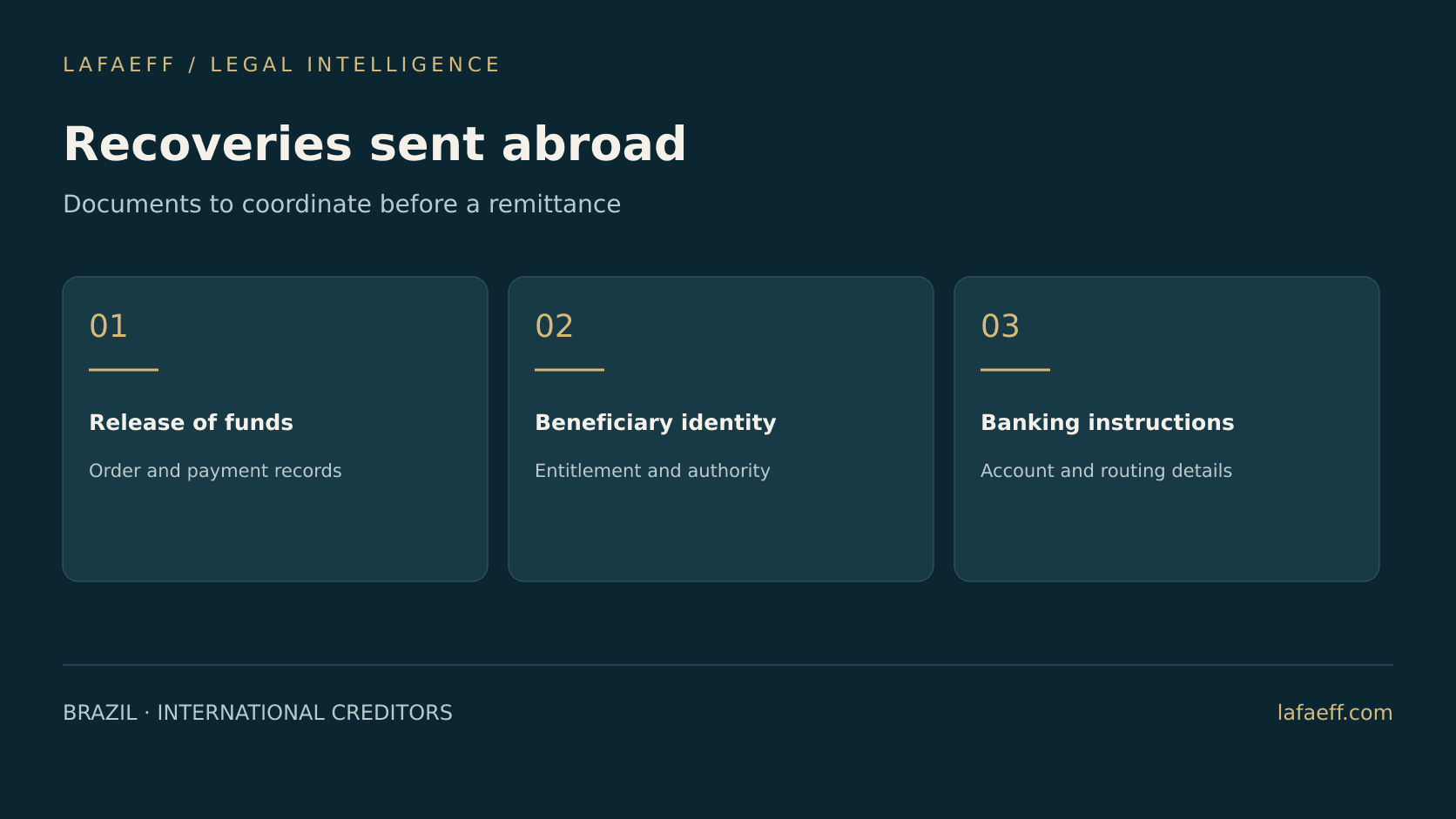
Foreign creditors should prepare for international payment alongside their Brazilian claim. The court order, beneficiary identification and foreign-exchange requirements need to support the same transaction and receiving party.
Legislation published onProperty outside the enforcement district may still be attached through the existing case. Title records and encumbrances guide the review.
Original source published onResidence, assets and treaty provisions require examination before concluding that security for litigation costs is unnecessary.
Original source published onIdentifying the correct notice and procedural stage is essential when filing a Brazilian insolvency claim. Administrative filings, discrepancy submissions and court objections have different recipients and deadlines, with additional documentary considerations for creditors holding records abroad.
Decision published onMissing from the creditor list does not necessarily preserve full-value recovery. A practical review for overseas businesses and lenders.
Original source published onA favourable overseas judgment must be connected to the specific result sought within Brazilian territory.
Original source published onInternational teams should distinguish annulment grounds from enforcement defences and track the applicable notification dates separately.
Original source published onReceivables require analysis of the specific security arrangement, rather than automatic treatment as plant or equipment.
Original source published onTransferring a claim requires separate checks on the assignment agreement, its effect against the debtor and the creditor records in insolvency proceedings. Evidence supporting one step does not automatically satisfy the others.
Original source published onA contested plan approval can affect the assessment of litigation expenses and court-awarded legal fees.
Original source published on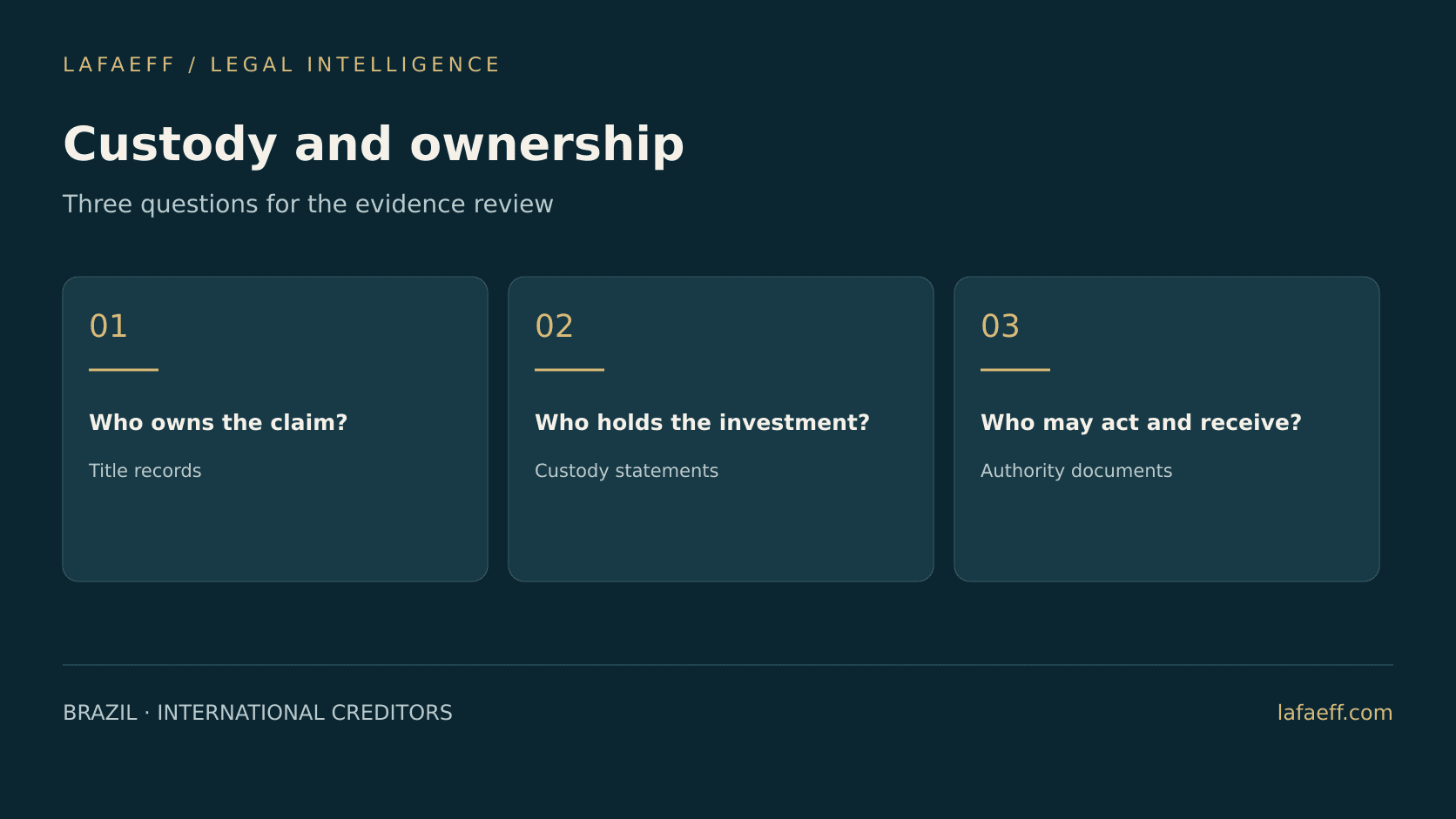
Managing a trust, holding assets in custody and benefiting economically from them are different functions. Acting on a Brazilian claim requires evidence of title and specific authority, rather than assumptions based on account records.
Legislation published onA judicial insurance policy is not immediately available cash. Foreign creditors should review coverage, triggering events and restructuring effects.
Original source published onBrazilian law protects foreign creditors against discrimination while preserving statutory claim priorities. Understand what commencement notices must explain, which claims receive exceptional treatment, and what evidence supports participation by an overseas creditor or an authorized representative.
Legislation published onBrazil's 2020 reform established a procedure for recognizing foreign insolvency proceedings and coordinating local relief. This article explains recognition requirements, main and non-main proceedings, documentary evidence, and the distinction between reorganization and bankruptcy.
Legislation published onA title such as liquidator, custodian or administrator does not establish authority to represent foreign insolvency proceedings. Brazilian law distinguishes standing to approach courts, participation after recognition, and authority over particular assets.
Legislation published onA judgment delivered after a reorganization filing does not necessarily create a post-filing claim. Theme 1051 requires identifying the event giving rise to the obligation, comparing it with the filing date and checking statutory exclusions.
Decision published onForeign investors should identify the financial instrument, registered holder and ownership chain before choosing a recovery procedure.
Original source published onHow overseas clients can organise documents, instructions and reporting with LAFAEFF for debt recovery, disputes and Brazilian proceedings.
Original source published onClosing a reorganisation does not necessarily mean every instalment has been paid. A 2020 judgment distinguishes these stages.
Original source published onREsp 1,656,643 addresses arbitral priority and exceptional judicial intervention when contractual scope is disputed.
Original source published onAn economic claim pending in arbitration may be relevant to asset recovery, subject to procedural requirements and uncertainty.
Original source published onForeign law firms should check the applicable service channel, recipient details, declarations and translation requirements before transmission.
Original source published onThe Alstom/Mitsui case illustrates why arbitration clauses and the limits of recognition review matter to insurance recoveries.
Original source published onForeign suppliers and lenders should compare eligibility, discounts and continuing obligations before assessing a Brazilian restructuring offer.
Original source published onForeign buyers should distinguish a court-approved business-unit sale from an ordinary acquisition and examine the protection actually available.
Original source published onForeign businesses and counsel should track partial awards and notice dates during a Brazil-seated arbitration rather than await the final outcome.
Original source published onOverseas businesses should preserve signature evidence and assess whether a digital contract supports direct Brazilian enforcement.
Original source published onA judgment's status abroad is part of Brazil's recognition assessment. STJ Bulletin 626 explains this requirement.
Original source published onRecognition planning should include tribunal composition, disclosures and challenges, alongside the award and evidence of Brazilian assets.
Original source published onEmails may support a Brazilian payment claim. Foreign suppliers should preserve complete conversations, attachments and evidence of performance.
Decision published onThe principal debtor's reorganization does not automatically suspend enforcement against guarantors. Applying Súmula 581 requires checking the guarantee instrument, consent to the plan, independent defenses and payments already received from any liable party.
Decision published onAn Apostille facilitates international use of documents but does not verify their substantive contents or authorize transactions. Corporate documents require separate examination of authentication, representative authority, and the receiving institution's requirements.
Original source published onA foreign power of attorney used in Brazilian proceedings must establish appropriate authority and satisfy documentary requirements. Receiving money and discharging obligations require specific authorization, while translation and authentication address separate legal issues.
Legislation published onLegal diligence on a Brazilian litigation claim must reconstruct its balance, identify restrictions and assess procedural status. A favorable judgment, the seller's stated amount and actual recoverability are separate matters requiring separate evidence.
Legislation published onA foreign non-judicial debt instrument differs from a foreign judgment. Brazilian counsel should assess the document before selecting the collection route.
Legislation published onForeign suppliers should assess the sales convention, delivery evidence and Brazilian collection procedure before pursuing an unpaid invoice.
Legislation published on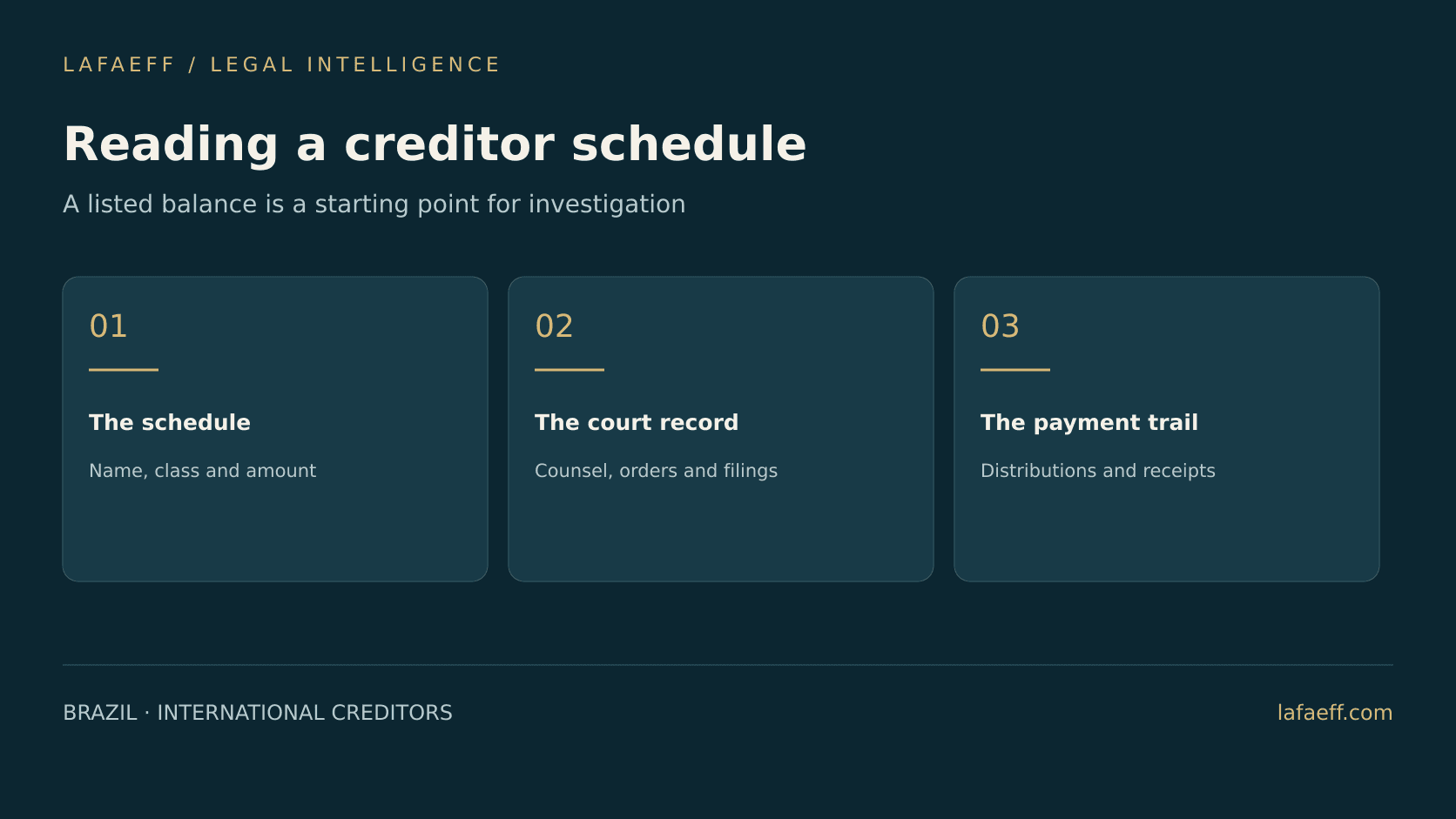
A creditor schedule organises admitted rights and ranking. A useful assessment connects the version consulted to court decisions, claim proceedings and payment evidence, rather than drawing conclusions from an isolated row.
Legislation published on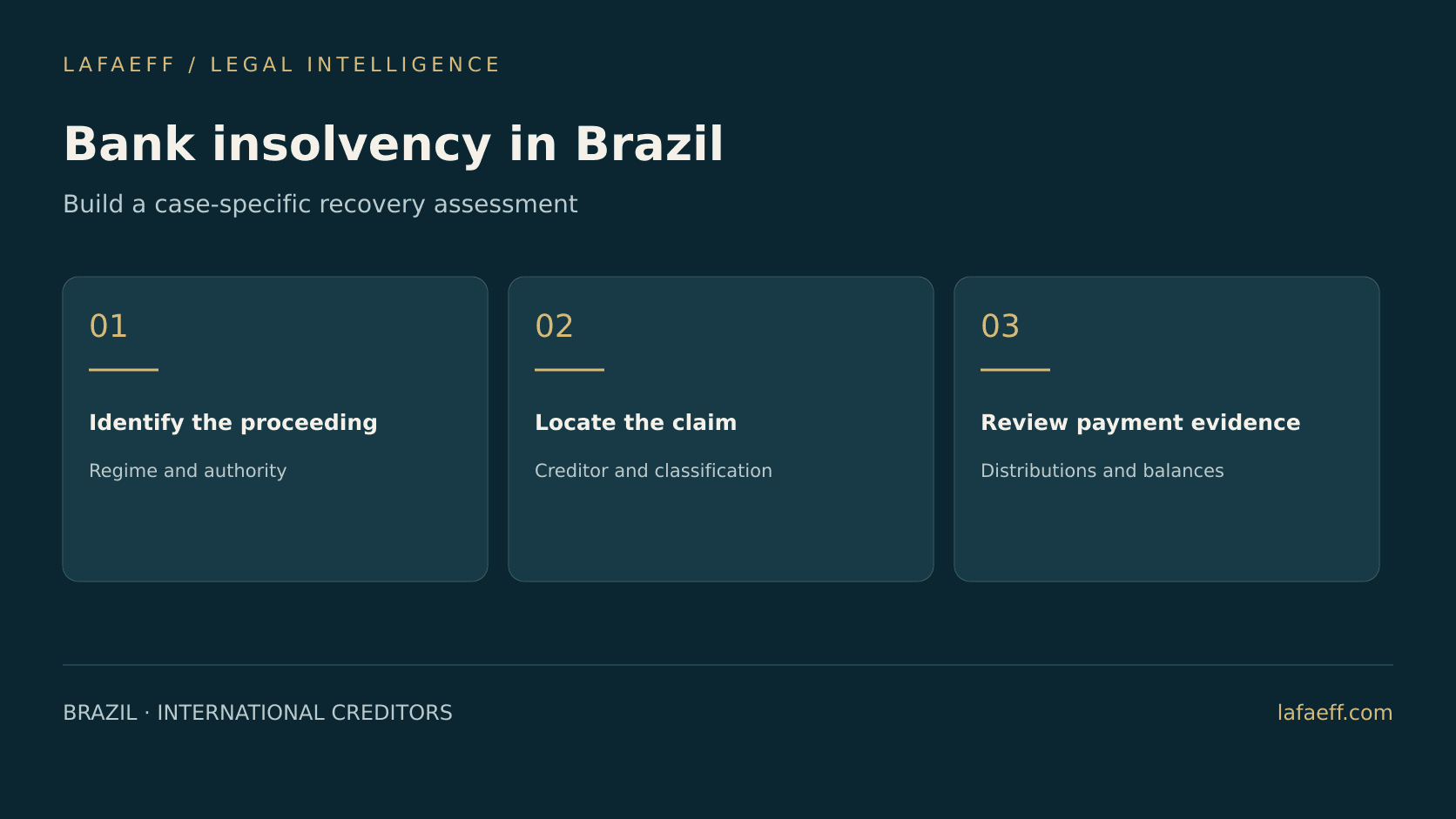
A financial institution's distress does not automatically follow ordinary corporate reorganisation procedures. Foreign creditors should first identify the applicable regime, responsible authority and subsequent decisions affecting their claims.
Legislation published onIn Theme 1,230, Brazil's Superior Court of Justice allowed exceptional attachment of earnings for non-support debts when other enforcement measures are unavailable and dignified subsistence is preserved.
Original source published onA concise institutional note on how evidence and organized information support responsible legal analysis.