
Business
Brazilian bankruptcy: filing a claim and understanding payment priority
In a Brazilian bankruptcy, proving a debt, having it recorded in the proceeding and receiving payment are separate steps. Evidence, statutory classification and available assets all matter.
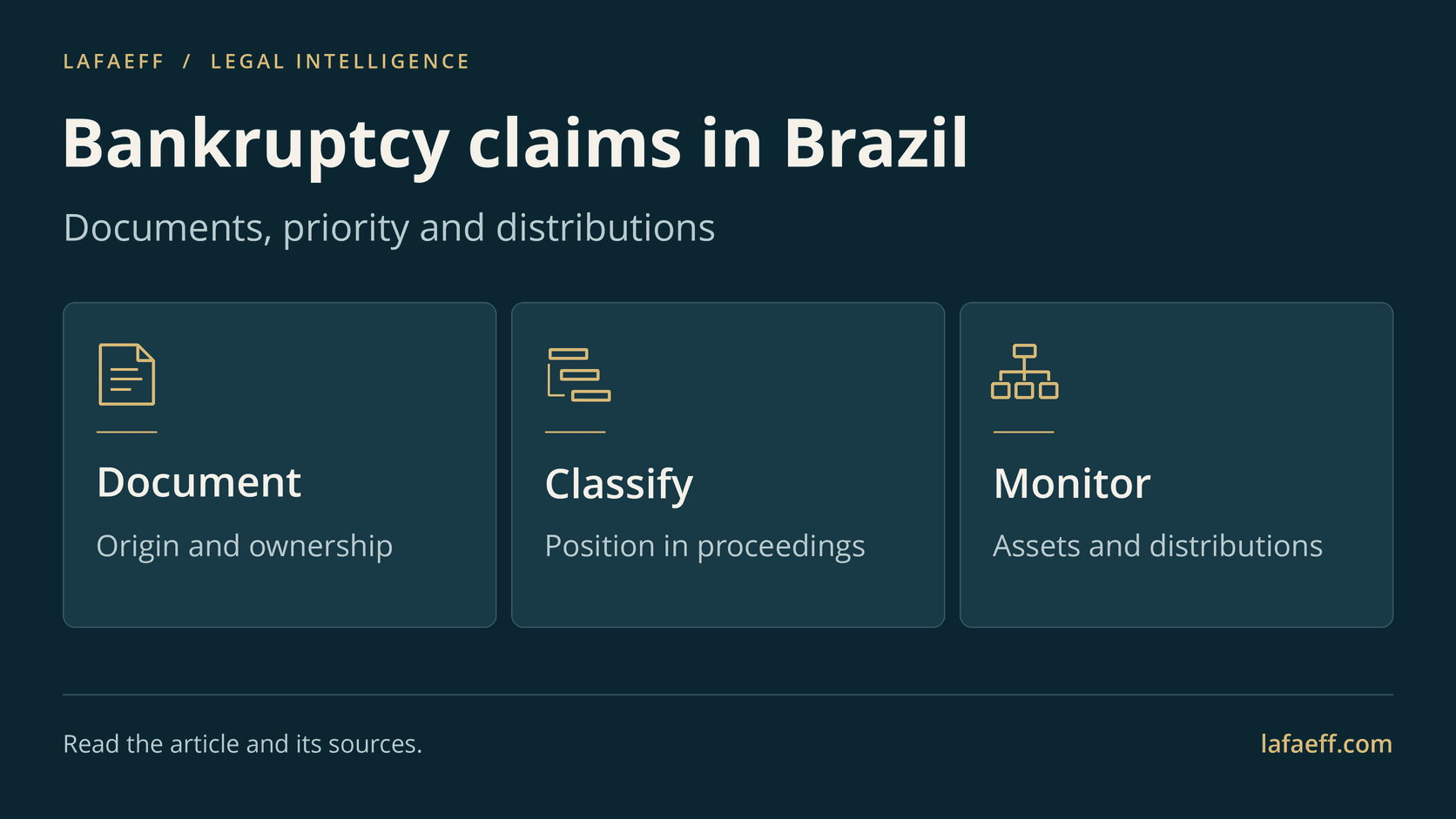
From the initial list to the creditors' register
Under Brazil's Bankruptcy and Reorganization Law (Law 11,101/2005), the court-appointed judicial administrator verifies claims using the debtor's records and evidence supplied by creditors. After the statutory notice, creditors can submit claims or challenge entries on the initial list. A creditor should check its identity, amount and classification in the published record. A contract or judgment establishing a debt does not, on its own, settle its treatment in the bankruptcy.
Evidence to organize
Article 9 requires the creditor's identification, the amount updated to the legally relevant date, the claim's origin and classification, supporting documents and any security instrument. A practical file may include:
- The contract, invoice, judgment or other document showing how the obligation arose.
- A calculation showing the amount and the relevant update date.
- Security documents and evidence of current ownership, including any assignment.
- Contact details for notices and a record of relevant court publications.
Cross-border claims can raise separate questions about translations, local representation, currency and documentary proof. This preparation list is not a substitute for assessing the particular claim.
Claims submitted after the initial period
Article 10 treats submissions after the initial phase under article 7 as late claims. Late filing does not mean automatic admission or identical procedural effects. The stage of the case, prior decisions and the statute's specific limit for filing or reserving a claim in bankruptcy must be checked.
Priority is different from recovery
Articles 83 and 84 distinguish statutory classes of claims from claims payable ahead of those classes. Under article 149, proceeds from realized assets are distributed after restitution and payment of qualifying priority expenses, subject to the statutory order, reserved amounts and court decisions. Entry in the creditors' register does not establish that enough assets exist or guarantee a recovery percentage or date.
Practical implications
Creditors should monitor notices, the administrator's list, challenges, the final register and asset realization. The appropriate course depends on the claim's origin, security, classification, timing and assets actually available.
Sources
Related legal services
Brazilian legal representation
LAFAEFF Advogados · Nikolai Lafaeff · OAB/SP 392.692.
Portuguese and English communication for clients and law firms abroad. An assessment considers the documents, the proposed scope and the legal measures available in Brazil.