
International
Reading Brazilian creditor schedules: claim amounts, representation and payment
A creditor schedule organises admitted rights and ranking. A useful assessment connects the version consulted to court decisions, claim proceedings and payment evidence, rather than drawing conclusions from an isolated row.
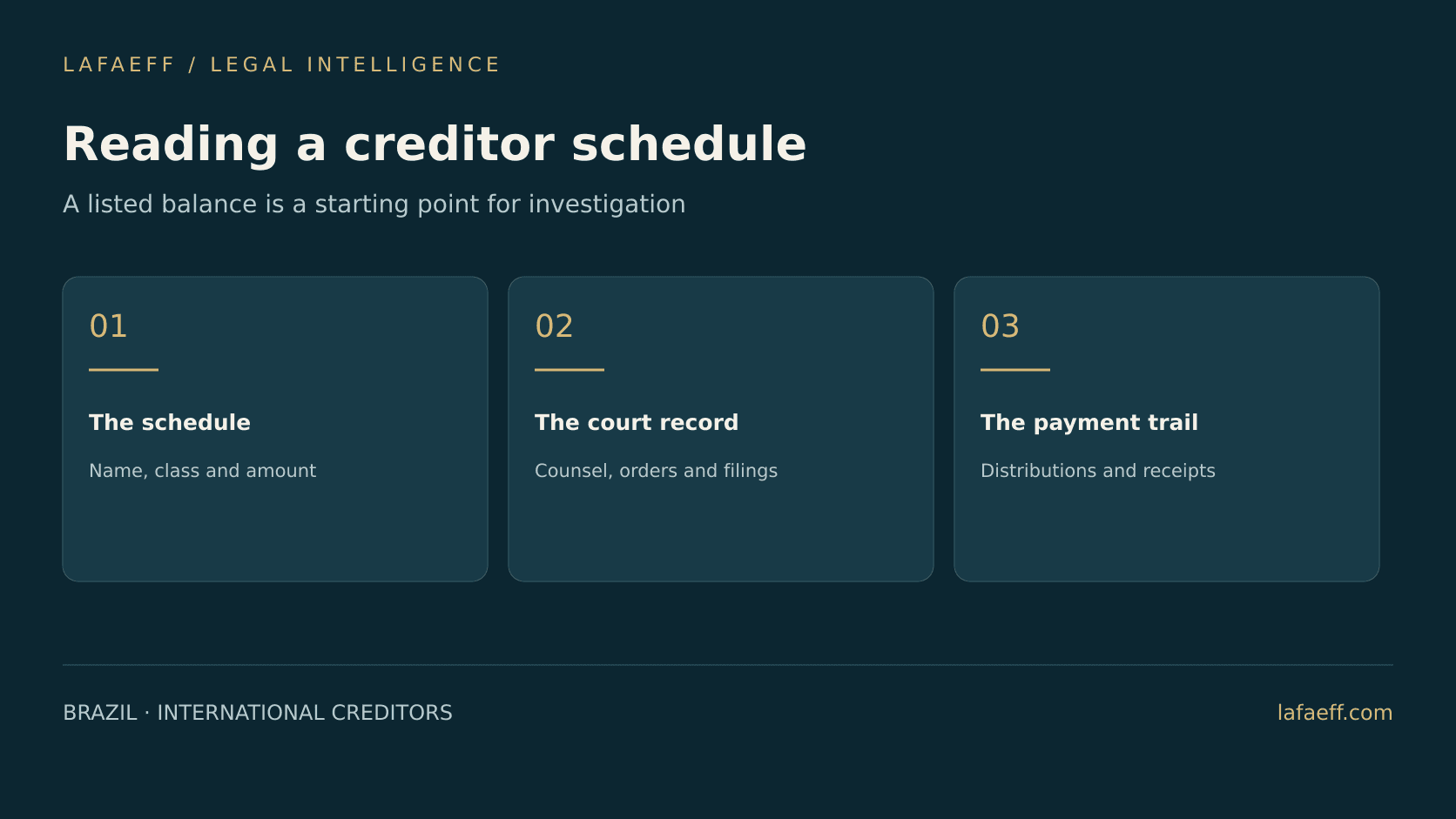
A creditor schedule is a documentary starting point. Under articles 7, 18 and 22 of Law 11,101/2005, the judicial administrator prepares the creditor list and consolidates the general schedule. Yet a row containing a name, amount and class does not answer every question about a claim. The document's purpose and date must be identified before conclusions are drawn.
The first distinction concerns versions. An initial list, a list following administrative verification, an approved general schedule and a table prepared for a particular distribution may describe different positions. Changes arising from objections, admission proceedings, succession or assignment should be reconciled with the relevant instruments. Comparisons should follow the same claim over time and avoid adding records that merely replace earlier entries.
The second distinction concerns payment. A published figure may be an admitted amount or a balance calculated for a specified purpose. Evidence of receipt requires other records, such as a receipt, transfer confirmation, estate accounts or the corresponding court filing. Missing payment data in a public table is a gap in that source, not proof that the creditor received nothing.
The third distinction concerns representation. Many schedules do not include a field for counsel. The absence of an attorney's name in that source does not establish that a creditor lacks legal assistance. Powers of attorney, substitutions, withdrawals, related claim proceedings and the procedural register should be examined together, with attention to their dates.
For an international team, an assessment record should identify the source, version, currency, ranking, restrictions and outstanding evidence. Article 22 also sets out the judicial administrator's information duties. This method turns a list into verifiable research while preserving the difference between an established fact, an unresolved issue and a recovery estimate.
Sources
Read the original source · Legislation published on
Related legal services
Brazilian legal representation
LAFAEFF Advogados · Nikolai Lafaeff · OAB/SP 392.692.
Portuguese and English communication for clients and law firms abroad. An assessment considers the documents, the proposed scope and the legal measures available in Brazil.