
International
Trustees, custodians and beneficial owners: proving authority over a claim
Managing a trust, holding assets in custody and benefiting economically from them are different functions. Acting on a Brazilian claim requires evidence of title and specific authority, rather than assumptions based on account records.
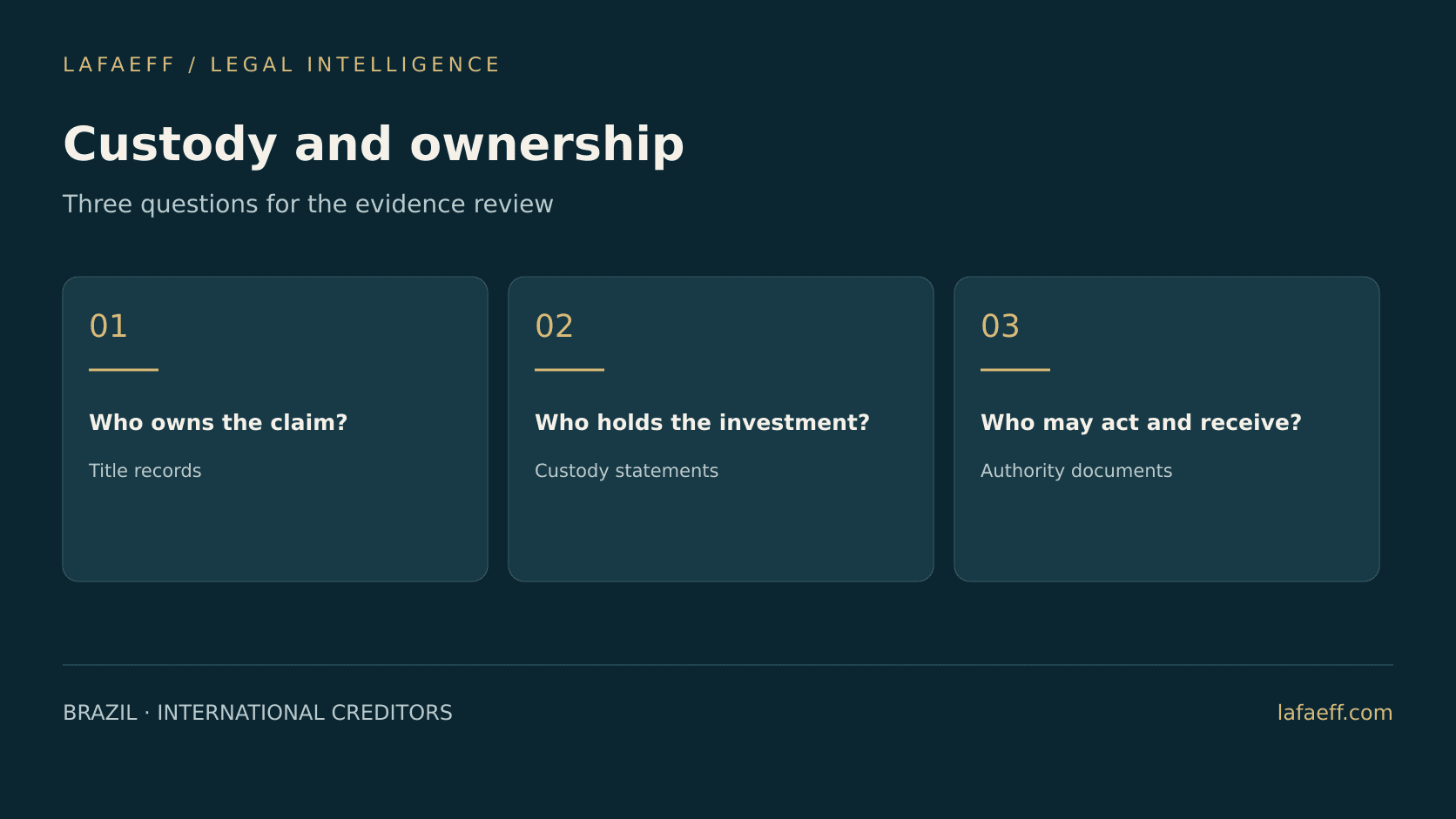
Documents concerning a Brazilian claim held through an overseas structure may identify a trustee, a custodian and an ultimate beneficial owner. Shared economic interests do not make these actors interchangeable. Before accepting collection, assignment or payment instructions, establish who holds the right and who has authority to perform the particular act.
Articles 2 and 8 of the HCCH Convention of 1 July 1985 describe the separation of trust assets and the connection between trustee powers, the trust instrument and governing law. Brazil is not listed as a party in the official status table consulted. The convention supplies a conceptual reference; it does not establish automatic recognition of a trust or universal trustee powers in Brazilian proceedings.
Custody serves a different purpose. For securities, CVM Resolution 32/2021 regulates safekeeping, position control and reconciliation, and requires a specific contract. That regulatory framework does not automatically cover every litigation claim. A custody statement may help document positions, but cannot alone establish authority to litigate, settle or transfer another person's rights.
A trust beneficiary must also be distinguished from an ultimate beneficial owner identified for regulatory purposes. CVM Resolution 50/2021 addresses natural persons connected through ownership, control, influence or benefit and provides specific diligence requirements for trusts. Identifying these people serves regulatory transparency; it does not automatically give a beneficiary direct title to the claim or authority to act in court.
The evidence should connect the trust instrument, current trustee appointment, custody agreement, chain of title and authorizations for the intended transaction. Where a lawyer acts under a power of attorney, receiving payment and granting discharge require specific authority under Civil Procedure Code article 105. Foreign documents must satisfy article 192's Portuguese translation requirements; the content and continued applicability of foreign law may require proof if ordered under article 376. Informational content prepared with AI assistance.
Sources
Read the original source · Legislation published on
- HCCH — Convention of 1 July 1985 on the Law Applicable to Trusts and on their Recognition, arts. 2 e 8 Published on date unavailable · Accessed on
- HCCH — tabela de partes da Convenção de 1985 sobre trusts Published on date unavailable · Accessed on
- CVM — Resolução nº 32/2021, arts. 1º, 2º e 10, e acesso ao texto consolidado Published on · Accessed on
- CVM — Resolução nº 50/2021, texto consolidado com Resoluções 179/2023 e 245/2026, arts. 2º e 15 Published on date unavailable · Accessed on
- Código de Processo Civil — Lei nº 13.105/2015, texto atualizado Published on date unavailable · Accessed on
Related legal services
Brazilian legal representation
LAFAEFF Advogados · Nikolai Lafaeff · OAB/SP 392.692.
Portuguese and English communication for clients and law firms abroad. An assessment considers the documents, the proposed scope and the legal measures available in Brazil.